An SEO crawler is software that automatically explores a website's pages to analyze its technical structure, internal links, HTML tags, and performance. It helps identify issues that prevent a site from being properly indexed by search engines.
Unlike Googlebot which crawls to index, an SEO crawler serves to audit a site before Google does. It's an essential tool for detecting technical errors, optimizing internal linking, and improving a site's crawlability.
An SEO crawler simulates Googlebot's behavior by methodically exploring a site's pages. Here are the 4 main steps of the crawling process:
The crawler starts with one or more seed URLs. These URLs serve as entry points to discover the entire site. This can be the homepage, an XML sitemap, or a specific list of URLs.
The crawler follows all internal links discovered on each page. It typically uses breadth-first (BFS) or depth-first (DFS) traversal to systematically explore all accessible pages.
The crawler checks the robots.txt file, respects meta robots tags (noindex, nofollow), and can be configured to ignore certain site sections. It also respects delays between requests to avoid overloading the server.
For each crawled page, the crawler collects technical data: HTTP code, response time, title, meta tags, H1-H6, internal and external links, canonicals, redirects, etc. This data is then analyzed to detect SEO issues.
Analogy: An SEO crawler works like a spider crawling a web: it starts from one point, follows each thread (link), maps the entire network, and notes damaged areas.
These terms are often confused, but they correspond to distinct stages of SEO:
| Term | Role |
|---|---|
| Crawler | Explores site pages to collect technical data (structure, links, tags, performance) |
| Indexing | Storage of pages in Google's index after analyzing their content and relevance |
| Ranking | Ordering of pages in search results based on their relevance to a given query |
| SEO Audit | Human or automated analysis of crawl results to identify optimization priorities |
Pages accessible in the sitemap or via direct URL, but not linked from other site pages. These pages receive no internal PageRank.
Spot broken pages, broken redirects, and server errors that block Google's crawling.
Visualize the site's link structure, identify low click-depth pages, and optimize internal PageRank distribution.
Detect pages with identical titles or meta descriptions, misconfigured canonicals, and URL variants that create duplication.
Identify unnecessary pages consuming crawl budget (filters, parameters, paginated pages) and prioritize strategic pages.
Unlike traditional SEO crawlers, SEOnsei doesn't just list thousands of technical data points. It prioritizes truly blocking issues and tracks their evolution over time.
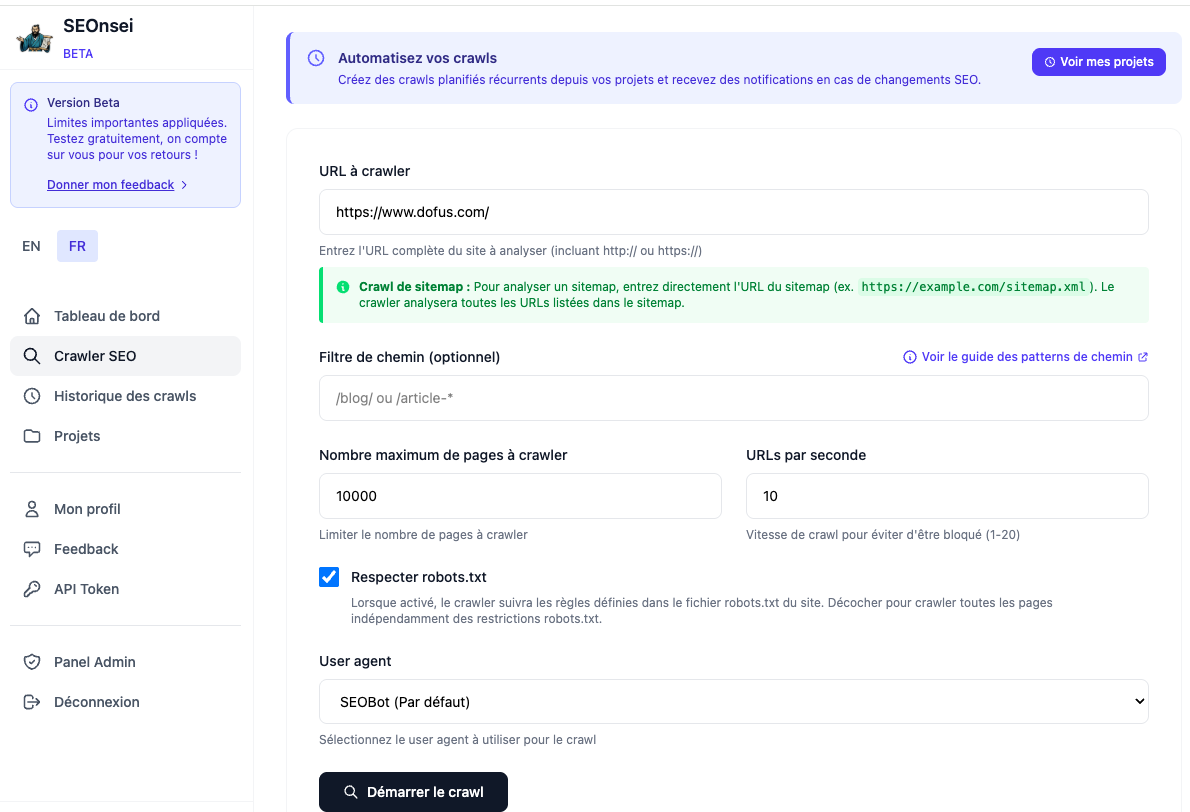
Simply enter your site's URL, configure a few optional parameters (max pages, crawl speed), and launch the analysis. Within minutes, you get a complete report with SEO score, prioritized issues, and actionable recommendations. No learning curve, no unnecessary complexity.
All your crawls are saved and accessible in a clear history. For each site, you can compare two crawls with one click to see what has improved or degraded: new issues, fixed issues, score evolution. This comparison is what transforms a simple audit into an SEO steering tool.
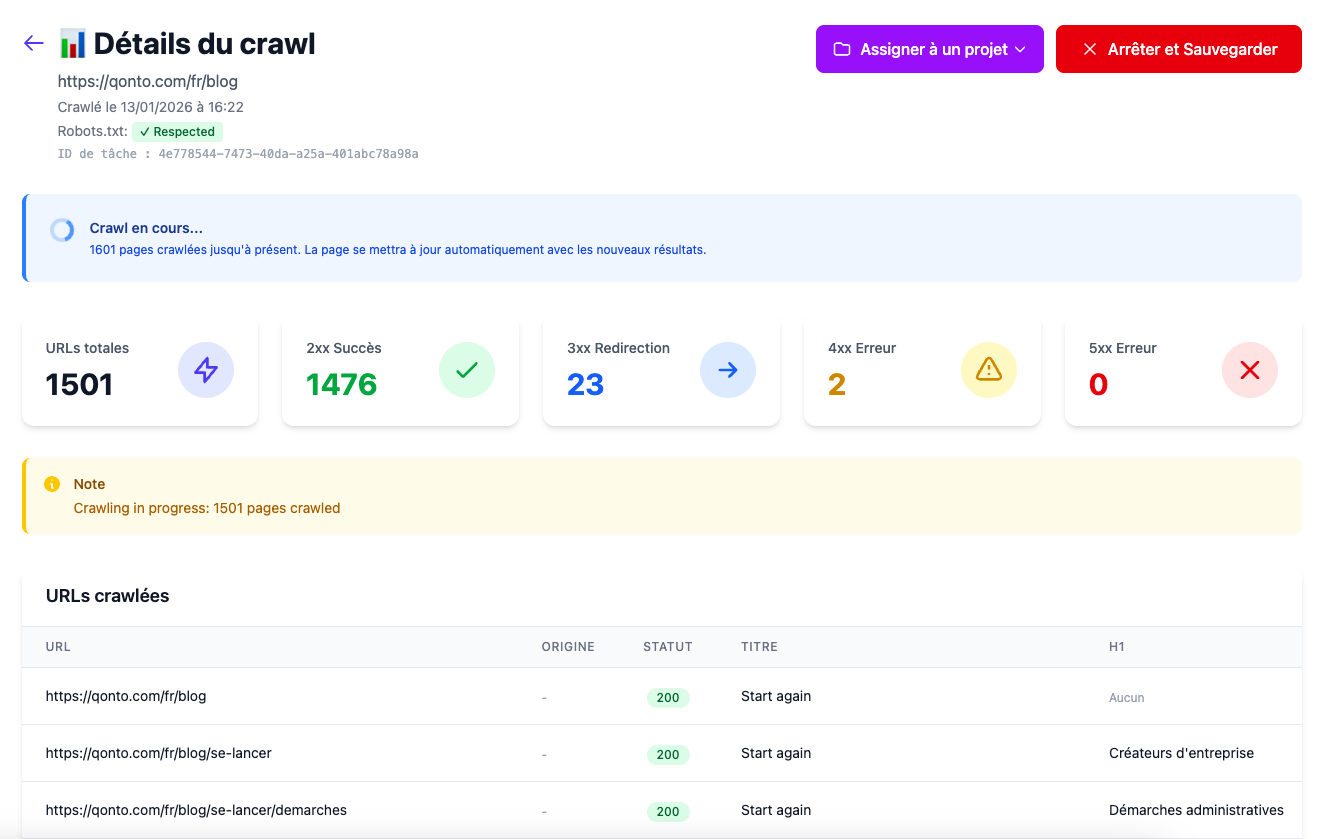
Schedule recurring crawls and get automatically alerted if your SEO score deteriorates.
Schedule daily, weekly, or monthly crawls for continuous monitoring.
Receive a notification if your SEO score drops or new critical issues appear.
Each crawl is automatically compared to the previous one to identify regressions.
Alert: Score decreased
SEO score dropped from 86 to 82 (-4 points). 3 new critical issues detected.
Critical / important / opportunity distinction to know where to start.
A score based on measurable criteria, comparable over time.
For clients and non-technical teams. No unnecessary SEO jargon.
Immediately see the impact of your fixes with comparable crawls.
Fixed issues, new issues, trends over time.
Schedule weekly or monthly crawls for continuous monitoring.
SEOnsei doesn't replace a one-time exploration crawler, it complements it with actionable tracking.
There are different types of SEO crawlers, each suited to specific needs:
Installed on your computer, they crawl from your machine. Suitable for one-time audits of small to medium sites. Limits: require keeping your computer on during crawling, no automatic time tracking.
Examples: Screaming Frog SEO Spider, Xenu's Link Sleuth
Hosted online, they crawl from remote servers. Suitable for large sites (> 10,000 URLs), recurring crawls, and time tracking. Advantage: no local resources needed, scheduled crawls, saved history.
Examples: SEOnsei, Oncrawl, Botify, Sitebulb Cloud
Optimized for sites with tens of thousands of pages (e-commerce, marketplaces, media sites). Handle JavaScript rendering, facets, filters, and differential crawling (only modified pages).
Examples: Botify, Oncrawl, DeepCrawl
Traditional crawlers only retrieve initial HTML. JavaScript sites (React, Vue, Angular) require rendering to see final content. Google uses delayed rendering, which can create gaps between what you see and what Google indexes.
Google first crawls raw HTML, then queues JavaScript rendering (which can take several days). Modern SEO crawlers can simulate this rendering to anticipate indexing issues.
Since 2019, Google primarily uses mobile versions of sites for indexing. A good SEO crawler must be able to simulate mobile crawling (smartphone user-agent) to detect differences between desktop and mobile.
Server logs show URLs actually crawled by Googlebot, while an SEO crawler explores what's theoretically accessible. Combining both gives a complete view: what Google can crawl vs what it actually crawls.
An SEO crawler doesn't replace Googlebot. It can't know if Google will index a page (algorithmic decision), nor predict ranking. It detects technical obstacles, but not content quality or relevance issues.
The SEOnsei SEO crawler produces a clear, actionable, and time-comparable report.
Overall SEO Score
The SEOnsei SEO crawler produces a clear, actionable, and time-comparable report.
View a sample reportNo server access required. Non-intrusive analysis.